Smoky
Tales From Otherworld: Collection OneSmoky is a central presence in the household surrounding Camille D’Artigo, where affection, danger, domesticity, and supernatural difference coexist. He is presented not through a formal biography but through the consequences of his actions: he helps sustain a crowded shared home, participates in its intimate celebrations, belongs to its web of partners and allies, and repeatedly turns practical tasks into scenes of comic peril. His decisive characterization lies in that contrast. Smoky is devoted and dependable in intention, yet his confidence can make him disastrously literal about what the household needs.
Identity and Place in the Household
Smoky belongs to the dense domestic network that includes Camille D’Artigo, Delilah D’Artigo, Menolly D’Artigo, Iris, Hanna, Trillian, Morio, Rozurial, Vanzir, Shade, Nerissa, and Maggie. The household is not merely a residence but a working community whose members cook, protect one another, share responsibilities, and gather for rituals and celebrations. Smoky’s role is therefore measured by participation. He is expected to contribute to the household’s everyday functioning, but he is also emotionally embedded in its intimate life.
His connection with Camille D’Artigo is explicitly romantic. When he explains his Thanksgiving purchase, he addresses her as “my love,” a form of address that makes his confidence in the kitchen simultaneously affectionate and alarming. The relationship is not limited to private sentiment: Smoky acts within the shared household, alongside Camille D’Artigo’s sisters and their companions, so that his romance is woven into a broader system of cooperation and mutual dependence.
Domestic Responsibility and Comic Disaster
The clearest episode revealing Smoky’s temperament occurs during the preparation for Thanksgiving. Camille D’Artigo has asked him to go to the store with Vanzir and select a turkey weighing about twenty-five pounds. The request is ordinary, but Smoky’s interpretation of it is not. Vanzir prefers to shop at The Natural Pantry, while Smoky has another destination in mind; because Smoky is still not entirely comfortable spending time with Vanzir, Vanzir avoids making an issue of the disagreement and goes along with him.
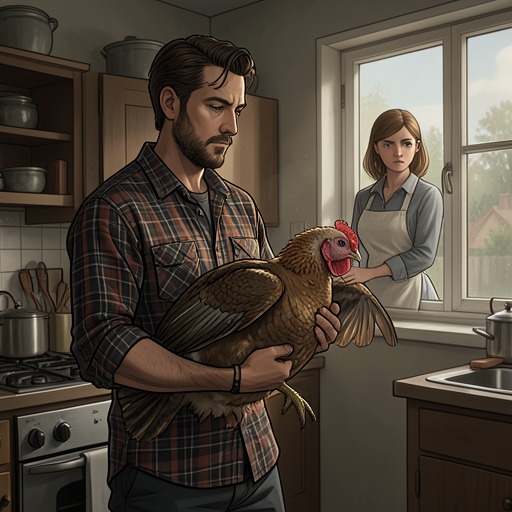
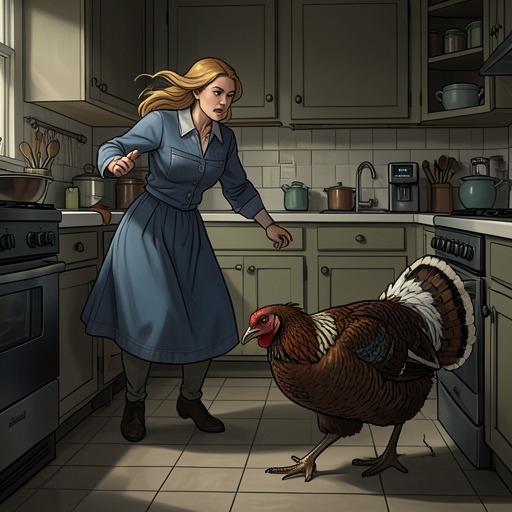
Smoky returns proudly carrying a large turkey under his arm, but the bird is alive, furious, and approximately the requested weight. He places it on the kitchen floor as though he has completed the errand successfully. The turkey struts through the room with its feathers spread, attacks Camille D’Artigo’s boot buckles, and transforms food preparation into an immediate household emergency. Smoky does not initially recognize the central problem. He proposes getting up early the next morning to chop off the turkey’s head and pluck it himself, treating the animal’s survival as a temporary inconvenience rather than proof that the purchase has gone catastrophically wrong.
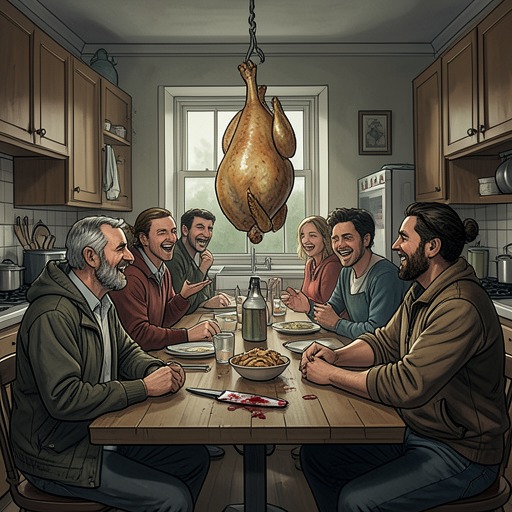
The episode exposes the gap between intention and consequence that defines Smoky’s comic function. He has fulfilled the visible requirement—a large turkey—but ignored the social and practical meaning of buying one for a holiday meal. His confidence intensifies the disorder because he presents the living bird as evidence of competence. Around him, the kitchen’s ordinary hierarchy breaks down: Iris objects to a turkey in her kitchen, Hanna objects to the creature itself, Vanzir arrives mussed and bleeding, and the bird wounds Rozurial when he tries to restrain it.
Smoky’s decision also activates Delilah D’Artigo’s animal nature. Fascinated by the angry bird, she shifts from her six-foot-one human form into a fluffy golden tabby and bounds after it. The turkey lunges at her, while Menolly D’Artigo attempts to intervene and ends up colliding with her sister. Thus Smoky’s mistake does more than create a joke about holiday cooking. It releases a chain of cross-species action in which the turkey possesses agency, Delilah D’Artigo becomes a pursuing cat, and the household members must negotiate whether the bird is food, threat, or an uncontrollable participant in their domestic space.
Affection, Cooperation, and Social Bonds
Despite the chaos he causes, Smoky is not isolated from the household. The Thanksgiving preparations show him assigned a concrete responsibility and trusted to perform it with Vanzir. Other members are likewise occupied with specific tasks: Iris manages soup, eggs, linens, and laundry; Hanna handles biscuits; Delilah D’Artigo peels apples; Morio slices them; Menolly arranges them in pie plates; and Camille D’Artigo removes eight pies from the oven after eight pumpkin pies have already been baked. The scale of the meal—sixteen people, including newly found cousins, and sixteen pies intended to last through the weekend—makes Smoky’s failed errand part of a genuine collective effort rather than an isolated prank.
His participation extends beyond labor. Smoky is among the household members who help stage an anniversary surprise for Camille D’Artigo. When she is sent toward Birchwater Pond under the pretext of recovering Delilah D’Artigo’s forgotten dagger, the majority of the household emerges from hiding: Morio and Smoky are among the first to jump out from behind the bushes, followed by Shade, Nerissa, Rozurial, and Vanzir. The picnic tables are covered with food, Christmas lights are strung through the trees, music is routed through the woods, and presents wait on a table. Smoky’s presence in this coordinated deception places him on the side of tenderness and communal celebration, contrasting sharply with his unmanageable turkey scheme.
The surprise also clarifies that Smoky can cooperate effectively when the goal is emotional rather than logistical. The same person who mishandles a simple shopping assignment can follow a plan designed to preserve secrecy and produce delight. His value to the household consequently does not depend on flawless competence. He belongs because he shows up, contributes to shared occasions, and takes part in the group’s reciprocal care.
The Supernatural Household and Its Animal Boundaries
Smoky’s scenes occur in a world where animal form, supernatural identity, and household membership overlap. The Thanksgiving turkey is an ordinary animal with enough will and physical force to resist being reduced to dinner. Delilah D’Artigo’s shift into a golden tabby shows a household member crossing the human-animal boundary deliberately, while Maggie is a woodland gargoyle whose calico fur resembles that of her dead mother. Arial, the twin sister of Delilah D’Artigo, can appear in a two-legged form only within Haseofon; outside it, she must wander the realms as a spirit leopard. These details establish that species is not a stable moral category in the narrative.
Within that framework, Smoky’s turkey episode becomes more revealing than a simple farce. He treats the bird as a resource and later as a task to be completed, while the bird behaves as an active subject with resistance, anger, and physical agency. Delilah D’Artigo responds to it as prey or playmate, and the others respond according to competing obligations: feeding the household, protecting themselves, controlling the animal, and preserving the kitchen. Smoky’s action therefore exposes the unstable line between companion, creature, meal, and danger that the household continually crosses.
The contrast with Maggie’s mother is especially significant. The ghostly woodland gargoyle approaches Maggie’s crib, recognizes the living child, and receives reassurance from Delilah D’Artigo and Menolly D’Artigo that they are caring for her. The dead mother leaves with sadness mingled with relief and joy. In that scene, an animal-like supernatural being is treated as a parent and enduring member of a family relationship. In Smoky’s Thanksgiving scene, by contrast, a living animal is initially treated as an object for consumption, yet its refusal to cooperate forces everyone to acknowledge its presence. Together, the episodes make household ethics depend less on species labels than on action, attachment, and the ability to affect others.
Seasonal Ritual and Narrative Function
Smoky’s role is also shaped by recurring communal and seasonal settings. Thanksgiving gathers the household around soup, biscuits, pies, eggs, apples, and the anticipated turkey; the failed purchase turns the preparation of a feast into a confrontation between domestic order and uncontrolled life. At Birchwater Pond, the household later gathers around food, music, lights, and presents for Camille D’Artigo’s anniversary. Around another fire at the pond, Delilah D’Artigo and Shade share private time while Autumn and the presence of Hi’ran give the season a supernatural charge, and the Harvestmen remain alert because something is believed to be underway.
These settings show why Smoky’s presence matters even when he is not the principal speaker or planner. He helps populate the household’s rituals, and his actions test whether those rituals can absorb surprise. The Thanksgiving meal cannot proceed according to plan once the turkey arrives alive; the anniversary celebration, however, succeeds because Smoky joins the group in preserving the surprise. His two modes—unintended disruption and purposeful participation—give the domestic scenes their characteristic instability.
Smoky therefore functions as both lover and communal actor, practical helper and comic trickster. His living-turkey mistake is memorable because it compresses his defining qualities into one escalating scene: generosity of scale, confidence in his own solution, disregard for ordinary procedure, and an underlying willingness to take responsibility for the consequences. His appearance at the anniversary surprise supplies the counterweight. He is not merely the source of household disorder; he is one of the people who makes the household a celebratory, protective, and emotionally connected community.